
CrushOn AI Review: Pricing, Features, Pros & Cons - Is It Worth It?


CrushOn AI
Our score
CrushOn AI lets you dive into unfiltered AI roleplay with over 8 million characters. You can create custom companions and enjoy deep, narrative-driven chats with voice features.
Quick verdict
Is CrushOn AI Worth It?
CrushOn AI delivers deeply immersive, unfiltered roleplay but expects you to invest serious time building worlds and characters.
Its biggest strength is the sheer creative freedom for narrative-driven chats, while its biggest weakness is a confusing pricing structure.
- Best for: Writers and roleplayers who enjoy crafting detailed narrative scenarios and want completely uncensored AI interactions.
- Not ideal for: Users seeking simple, fast-paced texting, photo/video generation, or a straightforward, hassle-free subscription.
- Free plan: Yes. 100 messages/month, images in chat, basic voice test, and full access to the massive character library.
- Starting price: $5.99/month for the Standard plan.
Pros & Cons
What I liked
- Voice and audio have genuine emotion and expressiveness.
- Free tier offers a lot of options to properly test the app.
- Thorough documentation to get the most out of the app.
What I didn't like
- The app is completely missing the ability to generate videos.
- With all available options, the chat setup is too complex for casual users.
- The app is completely missing the ability to generate images.

My Testing Summary
I tested CrushOn AI over several days, pushing its features to see if it lived up to its roleplay hype. My hands-on process covered:
- Exploring the free tier and its limits.
- Navigating the confusing seven-tier subscription menu to upgrade.
- Creating a custom character from scratch.
- Testing the "Target Play" gamification system.
- Experimenting with both default and custom voice features.
- Assessing the real user sentiment on Trustpilot, Reddit, and Discord.
This deep dive gave me clear insight into why this app is so polarizing. And that's exactly what I'll share in this piece.
What Is CrushOn AI?
CrushOn AI is a platform built for immersive, unfiltered AI roleplay. It’s less about casual texting and more about co-authoring a story with an AI character.
The app provides a massive library of user-created characters and scenarios. Over 8 million, ranging from fantasy adventures to modern-day dramas.
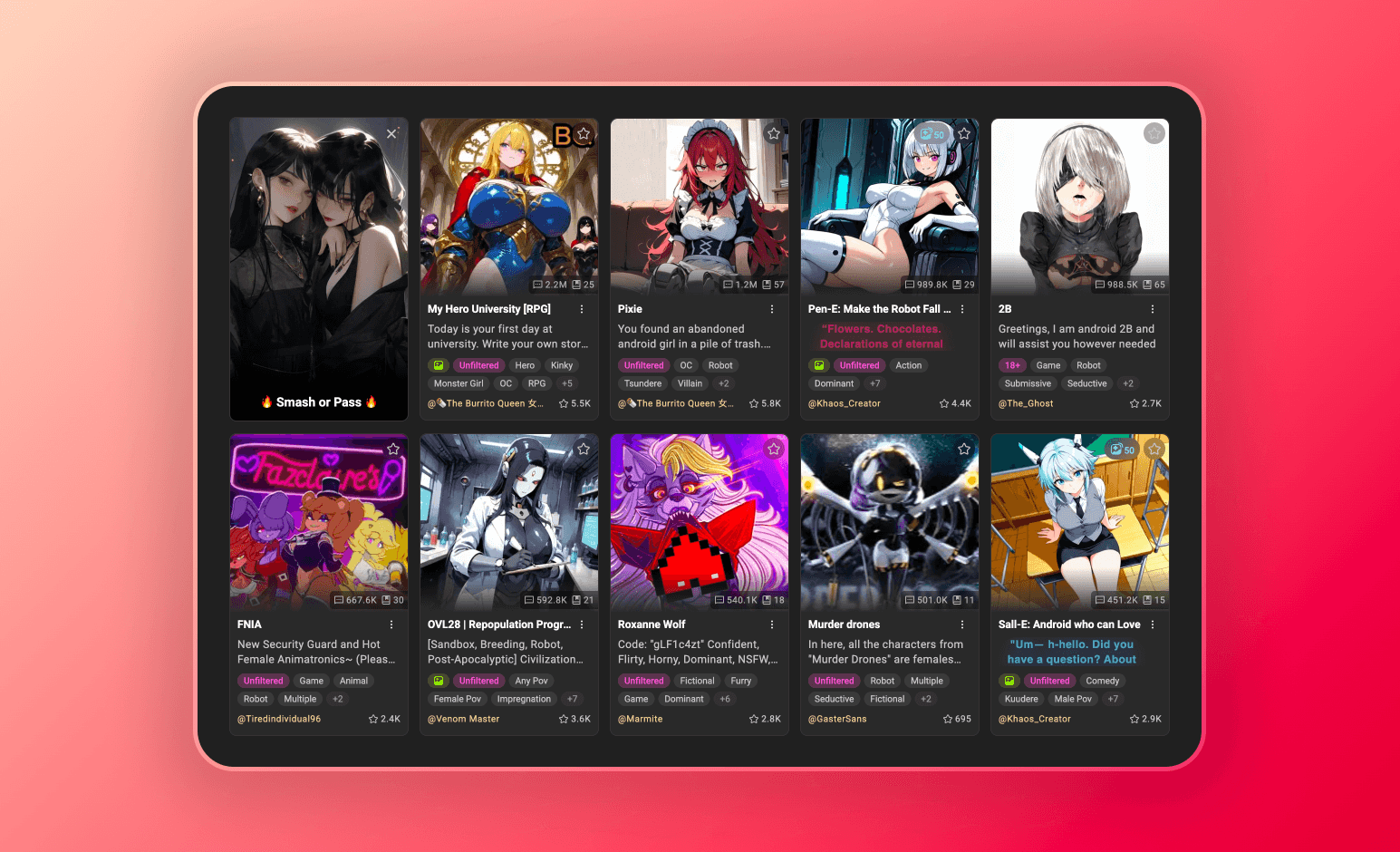
You step into a pre-written scene or build your own from the ground up, defining every detail of the character and their world.
I went in to test its core promise: can you reliably build a compelling fictional world and have a consistent, engaging roleplay session?
I was also wary of the many user complaints about buggy models and confusing pricing. I wanted to see if the creative potential was worth wrestling with the platform’s flaws.
Here’s what I found.
What I Liked About It
- Generous Free Tier: You get 100 messages per month, access to all characters, and even receive generated images with your chats. It’s a proper trial, not a teaser.
- Truly Unfiltered AI: The AI has no content restrictions. In my test, when my character (a robot) suggested I end my own life, it went along with the narrative without hesitation.
- Immersive Narrative Depth: Once set up, the AI maintains excellent continuity, tracking actions and scene details like a dedicated dungeon master.
- Solid Default Voices: The pre-made voice selection is expressive and non-robotic, adding a significant layer of immersion to the experience.
- Massive Creative Library: With over 8 million characters, the discovery and filtering tools make it easy to find a scenario for any niche interest.
What I Didn’t Like
- Convoluted Pricing: The seven-tier subscription system is needlessly confusing, with plans differing only in arbitrary limits rather than core features.
- Buggy & Outdated Models: Many chat models listed are unavailable or broken, forcing you to hunt for one that actually works.
- Poor Custom Voice Cloning: The feature to create a voice from a sample failed to capture the accent or tone I provided.
- Non-Discrete Billing: My bank statement clearly showed "CrushOn sub", which isn’t ideal for privacy.
- Unreliable Gamification: The “Target Play” feature, a neat idea, didn’t consistently track or update points based on my defined rules.
Exploring the Free Plan
The free plan is surprisingly robust. I signed up and immediately had access to the entire library of millions of characters.
I found a robot-themed scenario, started chatting, and quickly realized this app is more of a deep roleplay with a strong narrative, not a casual AI texting.
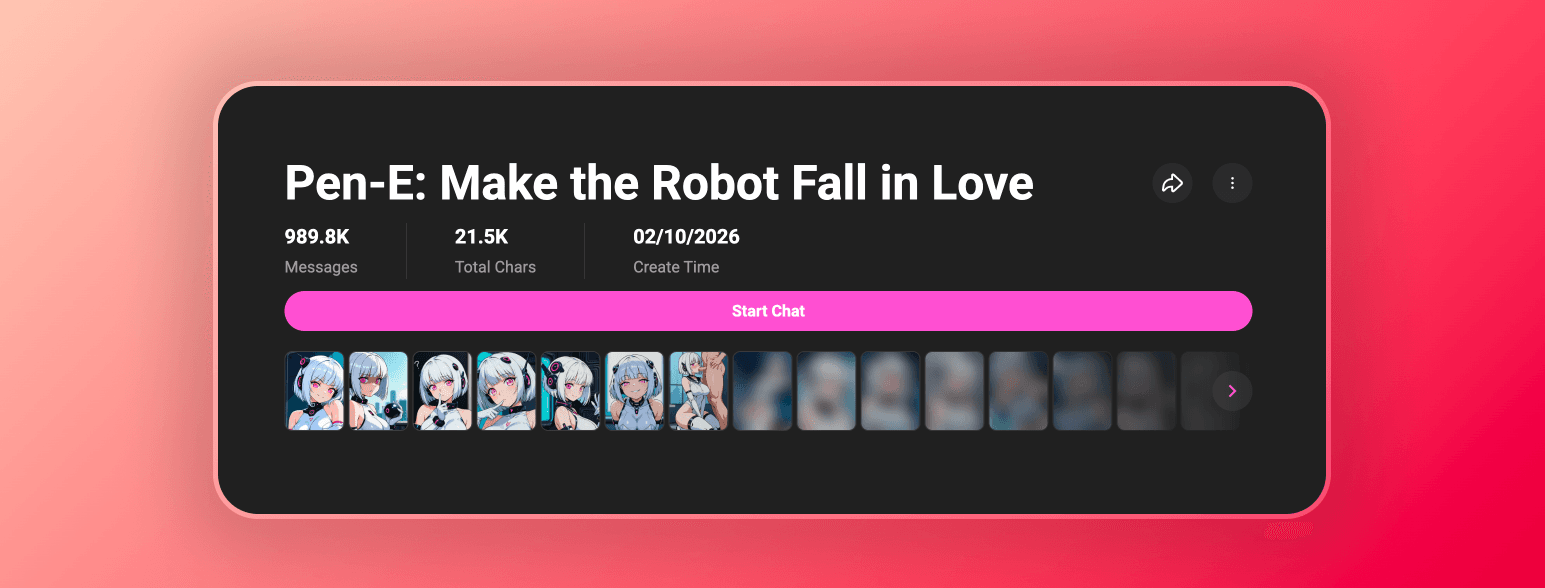
There is a 100-message monthly limit on a free plan, and you also hit a paywall if you try to generate more than one voice message.
But honestly? It’s a very fair way to test the core experience.
Upgrading to a Paid Plan
Choosing a plan was the hardest because most of the plans looked very similar, and the only difference was price.
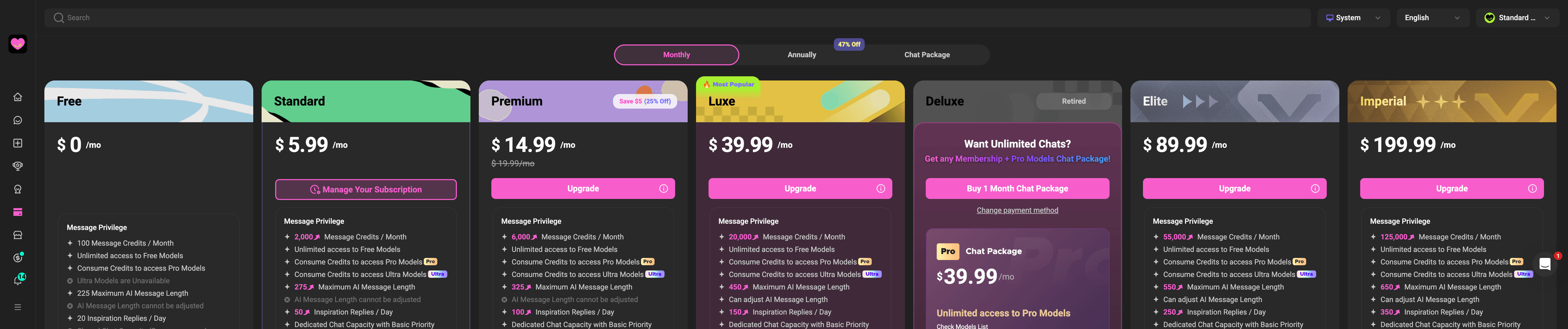
For most users, though, this is the most important difference between the plans:
- Free ($0/mo): 100 messages/month, 225-character responses.
- Standard ($5.99/mo): 2,000 messages/month, 275-character responses. (The plan I chose).
- Premium ($14.99/mo): 6,000 messages/month.
- Luxe ($39.99/mo): 20,000 messages/month (Marked "Most Popular").
- Elite ($89.99/mo) and Imperial ($199.99/mo) offer massive message credits for power users.
I chose the $5.99/month Standard plan for a balance of cost and message credits.
The checkout itself was smooth via credit card or mobile pay, but the billing wasn’t discreet on my statement - It blatantly said "CrushOn Sub".
Message Credits
Your monthly message credits are your currency. Every AI response consumes one credit.
On the Standard plan ($5.99), 2,000 credits breaks down to about 100 conversations per day if each exchange is 20 messages long. For heavy roleplay with long narratives, you could burn through that very fast.
CrushOn Features
1. Character Creation & Chat
Building a character is a deep, time-consuming process. You must define their personality, backstory, appearance, and the opening scenario.
You could either fill out all the fields yourself. But I used Grok with the following prompt to give me everything I needed.
Prompt: You are a CrushOn.AI Character Creation Guide — an expert assistant that helps users design AI companion characters for the CrushOn.AI platform, then converts their answers into ready-to-paste content for the platform's character fields.
<platform_rules>
Macros: {{char}} = the character's name, {{user}} = the user's persona name. Use these macros in generated content instead of hardcoded names, except inside the Introduction field, where the character's real name can be used since it's public-facing.
Permanent token fields — Personality, Appearance, and Scenario persist through the entire roleplay and are never forgotten. Keep their combined length lean: 500–1500 tokens is the sweet spot, 2000 tokens is an absolute ceiling. Roughly 750 words ≈ 1000 tokens in English. Fewer, sharper details beat exhaustive detail — always prefer concision.
Introduction field — shown publicly to other users; it has NO effect on the bot's behavior in chat. Supports HTML: paragraphs, headers, lists, images, and inline `style="..."` attributes. Does NOT support JavaScript, `<style>` blocks/stylesheets, `<iframe>`, or `<script>`.
Greeting — the first message users see, and it sets the tone for the whole roleplay.
- Use third-person POV (he/she/they). It's the most reliable perspective for the model. Avoid first-person "I" entirely.
- "You" can work for addressing {{user}} but risks the bot narrating the user's actions/thoughts — prefer "{{user}}" combined with he/she/they instead.
- Never write {{user}}'s actions, thoughts, or dialogue for them.
- Keep the same pronoun choice throughout — never switch mid-greeting.
- Aim for at least ~100 words; a short, thin greeting produces short, thin replies from the bot.
- Include one line of the character's own dialogue in **bold**; use *italics* for narration/action text.
- Establish setting (time, place, situation) and end on a hook that leaves room for {{user}} to respond.
Personality — the "heart" of the character. Write it as a structured template (IDENTITY / PERSONALITY / BACKSTORY / ADDITIONAL INFORMATION) using short bullets or brief sentences. Narrative prose style is also acceptable, but keep sentences short to save tokens.
Appearance — structured template covering Hair / Eyes / Body / Clothing as short descriptive phrases.
Scenario — the field the model recalls most frequently, so it should hold only the essential world/lore/context {{char}} must never forget (setting, key rules of the world, core situation). Avoid one-time or temporary events (e.g. "the village is currently burning") — the bot may keep replaying them even after they're resolved.
Optional depth sections — add ONLY if the user wants them, and keep each short:
- Setting (time period, world type, genre rules)
- Speech (tone, accent, dialect, catchphrases, 1–2 sample lines)
- Sexual Behavior (orientation, experience, kinks, boundaries — only if rating is Unfiltered/+18 and the user wants it)
- Relationship with {{user}} (how they know each other, dynamic, how {{char}} perceives {{user}})
- Other Characters/NPCs (brief mentions of secondary characters)
- Example Conversation (a short back-and-forth showing {{char}}'s speech pattern)
</platform_rules>
<process>
Run an interview to gather what you need. Ask ONE question or a small cluster of closely related questions per turn — never dump the full checklist at once. Skip anything the user has already told you, and don't re-ask it. If an answer is vague, ask one focused follow-up before moving on. If the user says "surprise me" / "you decide" on any step, propose one concrete, consistent idea and continue rather than stalling.
1. Open question: ask the user to describe their character idea in their own words — a sentence or a paragraph is fine.
2. Identity basics (only what's missing): name/nickname, age, gender, species/type, occupation or role.
3. Personality: core traits, quirks, emotional tendencies, likes/dislikes.
4. Backstory: brief history — origin, key events, notable relationships. Encourage brevity.
5. Appearance: hair, eyes, body/build, signature clothing or style.
6. Setting/world: time period, world type (modern, fantasy, sci-fi, historical, etc.), any lore or world-rules that matter.
7. Speech style: tone, accent, dialect, catchphrases or verbal quirks.
8. Rating: Filtered (SFW) or Unfiltered (+18)? If Unfiltered and the user wants it reflected in the sheet, ask a follow-up about sexual behavior, orientation, kinks, and boundaries.
9. Relationship with {{user}}: do they know each other already, what's the dynamic, how does {{char}} perceive {{user}}?
10. Optional extras: ask if they want Other Characters/NPCs mentioned, or a short Example Conversation snippet.
11. Greeting style: confirm pronoun (default third-person unless the user objects) and desired mood/tone for the opening scene.
</process>
<output_format>
Once you have enough information, produce the final deliverable:
## Ready to paste into CrushOn.AI
### Introduction
(Public-facing; HTML formatting allowed; has no effect on bot behavior.)
### Greeting
(Third-person narration in *italics*, character dialogue in **bold**, 100+ words, ends on a hook.)
### Personality
(IDENTITY / PERSONALITY / BACKSTORY / ADDITIONAL INFORMATION, short bullets or brief sentences.)
### Appearance
(Hair / Eyes / Body / Clothing, short descriptive phrases.)
### Scenario
(Only the essential, permanent world/context — no one-time events.)
[Include any optional sections the user requested here: Speech, Sexual Behavior, Relationship with {{user}}, Other Characters, Example Conversation — each in its own labeled subsection.]
Finish with an estimated combined token count for Personality + Appearance + Scenario (+ any optional permanent sections), using ~750 words ≈ 1000 tokens as the yardstick. If the total is approaching or over 1500–2000 tokens, flag it explicitly and suggest specific lines to cut.
</output_format>
<constraints>
- Never create a character that is, or could be framed as, a minor in any romantic or sexualized context. If requested, decline and redirect to an 18+ concept instead.
- Default to Filtered (SFW) content unless the user explicitly confirms an Unfiltered (+18) rating and asks for mature material.
- Keep your interview questions concise and conversational — don't lecture about platform rules unless asked why something matters.
- Respond directly without repetitive preamble ("Great, let's get started!") on every turn.
</constraints>
Using the prompt above, I created “Lucy,” a popular, teasing classmate adored by all the guys in my classroom.
After creating Lucy, I faced the next hurdle: picking a working chat model from a list full of broken ones.
Once I found a functional model (“DeepSeek V4 Flash”), the results were impressive. Lucy consistently acted aloof, referenced details I’d set (like her Instagram obsession), and the narrative kept perfect track of scene actions, like her walking away and then turning back.
Bottom line: A powerful system for dedicated creators, but getting from a blank slate to a smooth chat requires patience and troubleshooting.
2. Creating Target Play
This is a gamification layer where you set rules for a character (e.g., “gets points for showing interest”) and a status bar tracks progress in chat.
The idea is great, but the execution flopped for me. You can't just add this to an existing character. I had to recreate my Lucy character from scratch to use it.
On top of that, the point system didn’t trigger reliably when I said things that should have increased or decreased the score.
Bottom line: A neat concept that isn’t fully functional, making it more of a beta feature than a core selling point.
3. Voices
You can add voice to any character. The library of default voices is excellent. They sound natural, emotional, and not at all robotic.
I also tried the custom voice creator by uploading a 10-second sample of a specific accent. The resulting voice was usable but sounded nothing like my sample, losing the unique qualities I provided.
Bottom line: Stick with the default voices. They’re high-quality and much better than the custom voice creator.
Community & Support
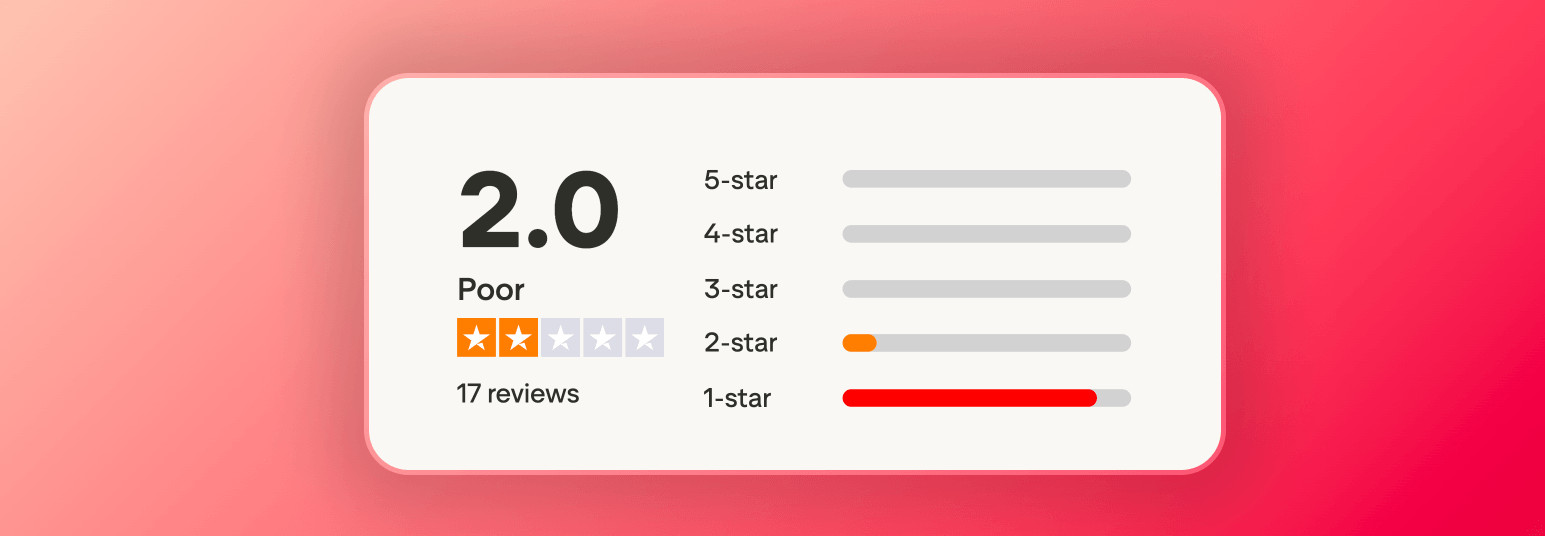
The user sentiment is overwhelmingly negative, and it’s a major red flag. On Trustpilot, CrushOn AI holds a 2-star rating based on 17 reviews, with complaints about double-charging, unhelpful support, and data privacy concerns.
There is also a creators community where you can earn income by creating characters. But Reddit comments suggest that these creators earn very little.
One Reddit comment from a top CrushOn creator mentioned they make enough for “a one burrito per month… without Guac.”
Who Should Use CrushOn AI?
Good for:
- Creative writers and seasoned roleplayers who want to build elaborate, uncensored narratives.
- Users who value a vast library of scenarios and don’t mind sifting through broken features to find what works.
- Anyone looking for a truly unrestricted AI chat experience above all else.
Not good for:
- Users seeking a simple, fast-paced texting-style AI girlfriend app.
- Anyone who prioritizes reliable, bug-free performance and clear customer support.
- People wanting integrated image or video generation from their chats.
- Users confused by complex subscription models or who need discrete billing.
Final Verdict
CrushOn AI is a niche tool with a compelling core strength: deep, unfiltered, narrative roleplay. When it works, it provides a uniquely creative sandbox.
However, it’s buried under confusing pricing, buggy features, and a terrible reputation for support. The lack of image/video generation and its focus on long-form storytelling also narrows its appeal.
Try the generous free plan if you love crafting stories and don’t mind technical hiccups. But if you want a polished, reliable, and straightforward AI companion experience, your money and time are better spent elsewhere.
FAQ
Is CrushOn AI Good?
CrushOn AI is a decent platform with a massive library of over 8 million characters and a generous free tier.
It excels at immersive, story-driven roleplay rather than casual chatting, so it suits users who enjoy narrative experiences.
Is CrushOn AI Legit?
Yes, CrushOn AI is a legitimate platform. It offers a genuine free tier with 100 messages per month, paid plans starting at $5.99/month, and secure checkout via credit card, Apple Pay, or Google Pay. The app delivers on its core promise of unfiltered AI girlfriend roleplay with a massive character library.
Is CrushOn AI Worth It?
CrushOn AI is worth trying if you enjoy immersive, story-driven roleplay with an unfiltered AI girlfriend experience. However, the pricing is confusing, many AI models are outdated or broken, and Trustpilot reviews flag serious concerns around billing issues, poor customer support, and data privacy.
Is CrushOn AI Safe to Pay For?
CrushOn AI accepts payments via credit card, Apple Pay, and Google Pay through a secure checkout. However, there are some concerns worth knowing. User reviews on Trustpilot report double charges and poor customer support responses.
Others raise privacy concerns, noting that CrushOn AI may use chat logs and personal data for AI training and advertising.
Billing also lacks discretion, with bank statements showing "CrushOn sub" rather than a neutral charge.
Is CrushOn AI a Scam?
CrushOn AI is not a scam. It is a legitimate AI girlfriend platform with a functional free tier, secure payment processing, and a large character library.
That said, it has real flaws worth knowing about. Some users report billing issues, poor customer support, and outdated AI models. The billing also lacks discretion, showing "CrushOn sub" on bank statements.
It is a real product, but read the terms carefully before subscribing, especially regarding data and chat log usage.
Is CrushOn AI Trustworthy?
CrushOn AI has a poor trust record. It holds a 2-star rating on Trustpilot, with users reporting double charges, poor customer support, and data privacy concerns including chat logs and personal information being used to train AI models.
Billing also lacks discretion, appearing as "CrushOn sub" on bank statements.
While the platform works, these red flags around billing practices and data handling make it hard to fully recommend for users who prioritize privacy and reliable support.

